Tuesday, May 24, 2016

Nearpod


Nearpod is an interactive presentation and assessment tool in the classroom. Teachers can create presentations that can include surveys/polls, quizzes, videos, images, drawing boards, and almost any other internet resource. Teachers can create a Nearpod presentation from the website https://nearpod.com/how-it-works or from the app https://appsto.re/us/5EjnF.i. The program and app are both free. The teacher creates an account, prepares a presentation, and the students join the session by entering an access code on their device. I would absolutely love to use Nearpod in my classroom! The instructional tool is so interactive that even as a college student, I loved participating in a simple lesson about shapes! I would definitely use Nearpod as a pre-assessment and post-assessment tool. I would begin the presentation with a poll or quiz to assess what my students already know about a topic. After the students have completed the pre-assessment portion, I would begin the bulk of the instruction through lecture, videos, images, etc. At the end of the presentation I would have a more detailed quiz or open-ended question to assess which students understood the information. Nearpod is an incredible twenty-first century tool that helps students actively participate in the learning process and deepen their understanding of covered material. 

Nearpod Tutorial

Social Interactions Among Students With Autism

One in sixty-eight children are born with autism. That means that in America alone, more than 3.5 million people live with an Autism Spectrum Disorder (ASD). A common characteristic among people living with an ASD is a persistent impairment in social communications and interactions. However, this does not mean that children with autism should be excluded from the typical classroom due to a social impairment. Rather, the classroom should be inclusive and teach social skills to all students, not only those with autism. The bottom line is that you will have children with an ASD in your classroom, and many of them will have trouble communicating and interacting with their peers. Typical students, however, usually are unable to interact with autistic children as well. Due to this fact, I plan to teach social skills to my entire classroom, not only to those with autism. This can be accomplished through a variety of strategies. Perhaps the simplest way is to create social stories for students to read/listen to and practice with a classmate. Another way is to create play groups. This can be done both inside and outside of the classroom. The goal of play groups is to teach proper social responses such as, “May I have that” and “Here you go.” Perhaps my favorite strategy, however, is assigning peer buddies/tutors. Research suggests that students learn best from their peers, so why shouldn’t we let them learn social skills from others as well? This promotes communication skills in all students and will lead to a better learning experience throughout the school year.


Social Story Apps:

Play Groups:


Peer Buddies/Tutors:

Flipping The Classroom


What is a flipped classroom? A flipped classroom is the literal opposite of a traditional classroom. In a flipped classroom, class time is devoted to exercises, projects, discussions, and other real-life applications. The lecture and instructional portion of a class is viewed by the students at home. I believe that there are several pros and cons to flipping your classroom. For example, a pro of flipping the classroom is that it gives the students more control and promotes the development of all four twenty-first century skills. Because students are no longer required to complete project work individually outside of the classroom, they learn how to communicate and collaborate with their peers in order to complete assignments. They are simultaneously improving their creativity and critical thinking skills since they are in control of their learning. The biggest downside to flipping the classroom is the limited access to technology. Many students do not have access to a computer or any other type of device at home. Because of this, it would be extremely difficult, if not impossible, for them to access the lectures and videos outside of the classroom. Due to this digital divide, I personally would only use the flipped classroom strategy in subject areas where students tend to struggle and need additional help such as math.This would allow students to get the extra help they need without losing class time or holding back the students who are ready to move on. Listed below are a few programs that are helpful when creating videos for your students to view at home.


Friday, May 20, 2016

Augmented Reality


Webster’s dictionary defines augmented reality as “a technology the superimposes a computer-generated image on a user’s view of the real world, thus providing a composite view.” What does that mean for the future of education? It means that our students are no longer limited to traditional classroom learning. Students can now explore virtual worlds within the classroom. If I want to teach a lesson to my students about the solar system, the students can scan a picture and be linked to a virtual solar system that they can actually explore and manipulate using the Aug That app. I can’t imagine a more fun or beneficial field trip for my students. I would also love to use the Aug That app for history lessons. Because of augmented reality programs, my students can literally dive into the learning process. They no longer have to read and research whichever historical figure or event I am teaching; they can actually see the events for themselves in a virtual world. Imagine if we all had learned this way! Augmented reality gives students the opportunity to collaborate with their peers in new ways while deepening their understanding of a topic. I can also assign students a topic, and they can create their own virtual worlds for their classmates to explore and learn about by connecting videos to an image. Augmented reality programs are definitely helping students learn and develop twenty-first century skills! Click below to create your free Aug That account now!

Green Screens

A green screen is a background in front of which moving objects are filmed. Using a green screen allows you to add separately filmed background to a final image. I always knew that green screens were used in movies, tv shows, music videos, and of course the weather. However, I never considered that teachers could use green screens in the classroom. All it really takes is a device, a good app, and a green background. Now that I know teachers have access to green screen apps, I realize that the possibilities are endless! As an elementary teacher I could use a green screen in any subject area. I would especially use them in History and English/Reading. So many historical movies are inappropriate for the elementary classroom, but allowing the students to familiarize themselves with a historical figure and portray that character in a movie-like setting would help deepen their understanding in so many ways! I would also love to use green screens during English/Reading. When I was in elementary school, we read a story, answered the questions, and took a test at the end of the week. I cannot imagine how much more my classmates and I would’ve enjoyed literature if we had actually gotten to portray the characters. I look forward to using green screen programs in my classroom one day to help my students learn twenty-first century skills. Asking students to portray a story, cover a topic, or even create their own work gives them an opportunity to use all four of the major skills—communication, creativity, collaboration, and critical thinking. A few green screen apps for iOS devices are Green Screen by Do Ink ($2.99), Veescope Live Green Screen App ($2.99), Green Screen Studio ($4.99). Below is a short tutorial for how to use Green Screen by Do Ink (widely recommended among teacher).

Wednesday, May 18, 2016

Reading Comprehension in Children With Autism

Reading comprehension is the ability to read text, process it, and understand its meaning. Comprehending literature is challenging enough for students who are developing typically. However, students on the Autism Spectrum typically experience even more difficulty. Students with Autism Spectrum Disorders (ASD’s) generally demonstrate well-developed word recognition skills, but are severely impaired in reading comprehension. This is known as Hyperlexia. Because students with ASD’s do not react as well to paper and pencil strategies, the use of iPads is extremely beneficial. There are a vast number of research-based apps that promote reading and comprehension skills in both students with and without any type of disorder. The link http://www.autismpluggedin.com/2012/08/autism-reading-comprehension-apps-for-children-with-autism.html lists a few apps that help students with autism—no matter what level—develop reading comprehension skills. I would definitely download these apps in my own classroom to work with autistic children. I would use apps that read the words aloud for students who are severely impaired and use the apps that do not read aloud for higher level students. Not only will students with ASD’s develop reading comprehension skills, but they might also develop critical thinking and communication skills while using these applications. This could lead to increased social interaction with their peers. Some of my classmates found additional apps that are excellent to use when working with children on the Autism Spectrum!
Inference Clues
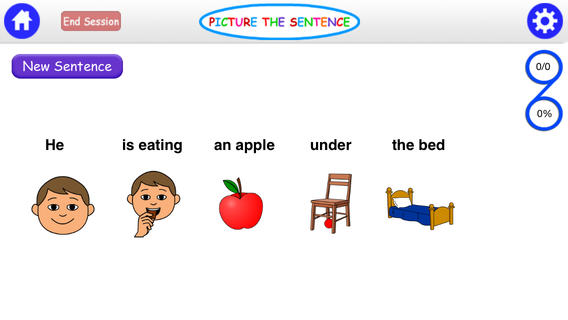
Picture the Sentence Lite

Noodle Words


Reading Comprehension Camp (Smarty Ears)

Socrative

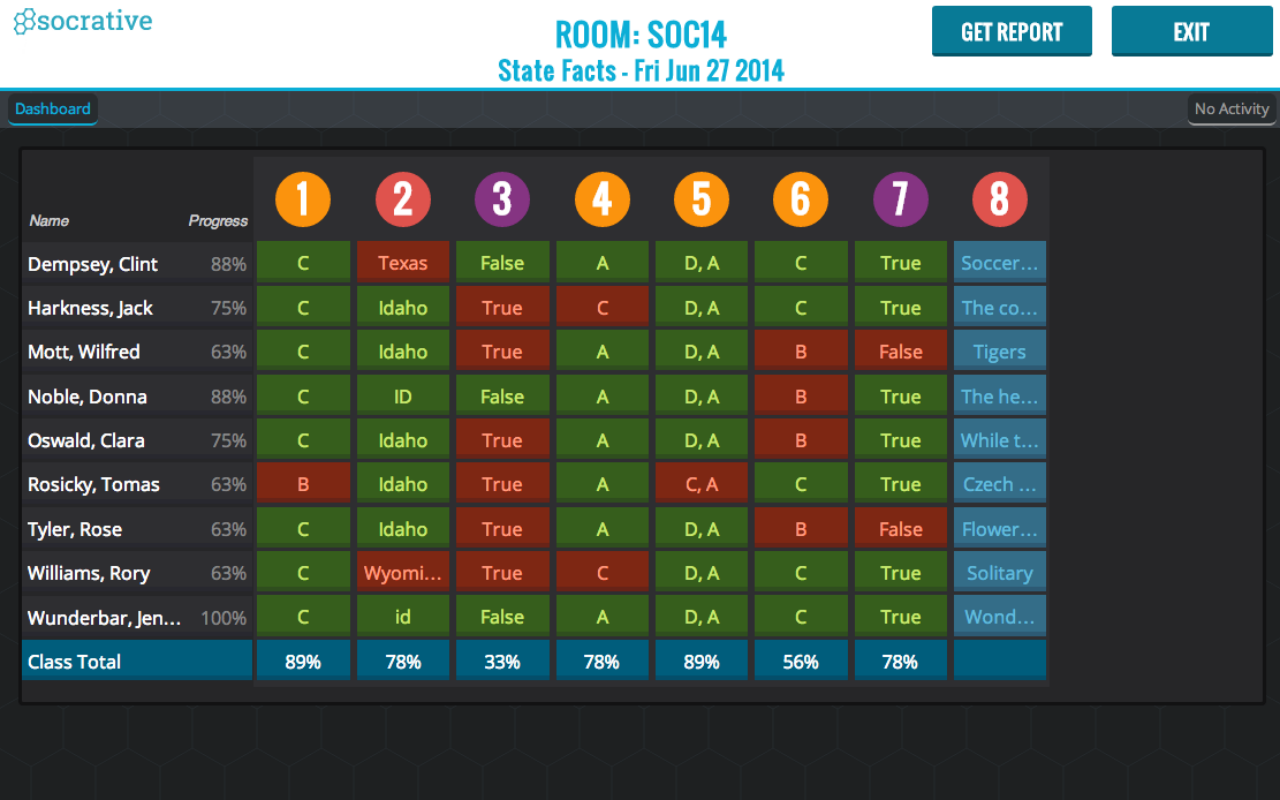
Sample Image of Classroom Results

Socrative by MasteryConnect is a program that allows teachers to collect assessment data through real-time questioning and result aggregation. Some of the pros to using Socrative are that it lets teachers immediately assess student learning, respond instantly, and gives students immediate access to their classmates’ ideas. A downside to using Socrative is that since it is an online quiz tool, only teachers who carefully plan and put time into making a Socrative quiz an effective assignment will reap the benefits of using the online tool in the classroom. Doing so can at times become very time consuming. Not only can teachers create online quizzes for their own students, but they can also create a Personal Learning Network to share resources and assessments with other teachers. This helps develop communication and collaboration skills in teachers and students as their share resources, ideas, and products with other classrooms in the school, community, or even nationwide. If I were using Socrative in my own classroom, I would definitely take advantage of sharing resources and assessments with the other teachers in my grade level. However, the best feature in Socrative could easily be its ability to align resources to both the state and Common Core Standards. How quick and efficient would that be! Follow the link below to set up your free Socrative account now!

Tuesday, May 17, 2016

Plickers


Plickers is a simple tool that allows teachers to collect formative assessment data quickly and efficiently without using student technology. You can create a quiz using Plickers either through the website https://plickers.com/ or the app https://appsto.re/us/XGZYP.i. The application allows you to create multiple choice quizzes or surveys for your students to complete. When using Plickers in the classroom, a teacher would create the assessment, display it for the class or group of students to see, distribute personalized cards with the answer choices, and scan the room with an iOS or Android device to see the students’ responses. The results will appear on the teacher’s device so that he/she may review which students are participating and how well they are doing on the particular assessment. Plickers promotes communication and critical thinking in the elementary classroom because students must be able to follow directions and read/answer the questions. If I were using Plickers in my own classroom, I might provide students with the opportunity to create their own quizzes for their classmates to take in order to teach collaboration and creativity skills as well. However, what makes Plickers so great is that you only need one device to use the application, yours! If your students do not have regular access to a device, then I definitely recommend using Plickers! 

Watch this short YouTube video to see Plickers in action!


Blendspace


Blendspace by TES is a free web tool that teachers and/or students can use to compile and store a collection of resources. Teachers can pull information from the internet such as website links, online quizzes, worksheets, and more. They can also upload videos from places like YouTube. Also, information can be pulled from social media accounts such as Facebook and Flickr. This would be an extremely useful time management tool in an elementary classroom because attempting to pull up multiple resource during a lesson would be impractical and time consuming. Not to mention, students would begin to lose interest. By using Blendspace in the elementary classroom, teachers can compile information, assignments, and assessments beforehand and have the entire lesson prepared and readily available for the students to access and complete. If I were using Blendspace in my classroom I would use it to introduce new units or topics. The system would allow me to collect a wide variety of instructional material to thoroughly introduce the unit/topic. I would also assign students group research using the application. By doing so, my students could expand upon the information that I presented and broaden their knowledge of the assigned topic. Having the students work in groups like this would teach communication and collaboration, as well as creativity and critical thinking. Assigning students research topics allows them the freedom to explore the topic from any direction while teaching them the skills they need to evaluate whether certain information is useful or irrelevant. 
Below is a YouTube tutorial of how to use Blendspace!

Monday, May 16, 2016

EDpuzzle


EDpuzzle is an incredible and free app to use in the classroom! The app allows you to combine videos, voice recordings, and quizzes for your students. The app is simple and easily accessible for students. EDpuzzle helps students develop twenty-first century skills, especially critical thinking and creativity. Not only do students exhibit these skills as they watch videos and participate in interactive quizzes, but they also have the opportunity to create their own puzzles. For example, teachers can assign each student a topic and have them create an EDpuzzle for their classmates to view and be tested on. This allows students to master a particular topic and share that knowledge with their class. Having the students work in groups would also help them develop other skills such as communication and collaboration. If I were going to use EDpuzzle in my classroom, I would use it in centers or as a project assignment. I believe that it would benefit the students more to use the app independently or in small groups so that the entire class would not be listening to the same video at once. Working individually or in groups also allows students to watch the video and answer the questions at their own pace. As I mentioned earlier, EDpuzzle would also be an excellent tool for mastery projects. Students are able to master skills and topics, share that knowledge with the class, and learn from their fellow classmates with one simple assignment!

Monday, April 11, 2016

Read A Book or Eat A Snack?

Did you know that reading a book is just like eating your favorite snack? My kindergarteners sure do! Just like books, food labels have pictures, words, letters, and a front/black. Sounds just like a book doesn't it? If your students are bored with traditional lessons about Concepts of Print, try this one on for size. Elementary students love to go on scavenger hunts, and what better way than to incorporate one of their favorite things-- FOOD! If you want a technology component too, try PicCollage. They can take pictures and make a collage of all their findings!


STEAMtastic!

STEAM! STEAM! We all scream for STEAM! Kids love STEAM, I love STEAM, and basically my entire college class does too! Throughout the semester, we have learned to teach math, art, and science, in addition to incorporating technology in every lesson. For once, however, we got to work on all of these things at once! The result was more fun than anything we had imagined!


Thursday, February 4, 2016

Digital Storytelling is so much FUN!

       I knew that digital storytelling would be fun for our students, but I never realized that it would be every bit as much fun for teachers! After an exciting "Play Day" in 21st Century Teaching and Learning, I am officially an advocate for teachers exploring the wonderful world of storytelling apps! Although my classmates and I just acted silly while playing with these apps, there are so many possibilities for our students to explore their ideas and thoughts! Here is a silly example of digital storytelling using the app "Telestory" with one of my classmates!


Tuesday, February 2, 2016

Becoming Better Teachers Because of Our Students

       Why should teachers use digital storytelling? There are so many reasons to use digital storytelling in the classroom, but there is only reason that teachers really need. It gives our students numerous outlets to express and explore themselves and their ideas. Other reasons include: developing communicative skills, promoting creativity, and encouraging critical thinking. After learning about some new and exciting apps during class, I am most excited about learning how to use "Telestory" and "My Story." I think students will really enjoy being creative to tell a number of different stories! I can't wait to start planning a "Retell" lesson using some of these awesome new apps!


Friday, January 22, 2016

Why Education? The better question is why not.

    Why do I want to be a teacher? The answer is really quite simple. I want to help children "see the world not as it is, but as it could be if only you believe in courage and kindness and occasionally just a little bit of magic" (Cinderella, 2015). Now perhaps this sounds a tad cliche, but the purity of the statement is better put than I could have ever hoped to do myself. Education is the best way for children to have a profound impact on this world. My hope as a teacher is to instill such a foundation of knowledge, courage, and kindness in my students that they have the opportunity to change the world more than I ever will or could.